
The Indian retail industry is experiencing an exciting phase of transformation, driven by steady economic growth, rapid technological advancements, and evolving consumer preferences. As one of the fastest-growing retail markets in the world, it is not only a significant contributor to the nation’s economy but also a hub of innovation and opportunity. From modern retail formats to digital platforms, the sector is continuously adapting, creating new avenues for businesses, enhancing customer experiences, and shaping the future of shopping in India.
Expanding Horizons of the Indian Retail Industry
The Indian retail sector stands as a powerhouse of economic activity, contributing more than 10% to the nation’s GDP and providing employment to nearly 8% of the workforce. With a market that ranks as the fourth-largest in the world, the sector is creating vast opportunities, shaping livelihoods, and playing a pivotal role in India’s growth story.
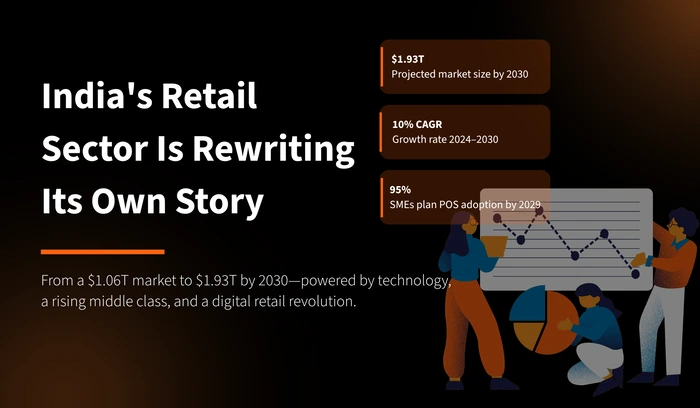
The latest Deloitte and FICCI report, “Spotting India’s PRIME Innovation Moment” highlights the transformative potential of the Indian retail sector. Valued at USD 1.06 trillion in 2024, the market is projected to nearly double to USD 1.93 trillion by 2030, growing at a strong 10% CAGR. This remarkable growth trajectory not only reflects the sector’s expanding scale but also signals immense opportunities for innovation, investment, and modernization across both traditional and digital retail landscapes.
India today ranks among the most attractive destinations for retail investment, supported by its demographic advantage, the world’s largest population, a growing middle-income segment of ~158 million households, increasing urbanisation, connected rural consumers, and rising household spending.
However, the retail sector, which has seen more disruptions in the past few years than other industries, evolving all the time to integrate the benefits of each disruption, continues to use the capabilities of new and emerging technologies. As the industry enters a defining era, accelerating the adoption of advanced technological capabilities will be key to catering to the evolving demands of a diverse consumer base, unlocking untapped growth potential, and shaping the future of retail in India as a global benchmark for innovation and resilience.
Current State of Technology Adoption
Time to check in on how Indian retailers are handling technology—some are leading the charge, while others are still figuring out which side of the digital divide they’re on.
A recent survey of over 1,000 Indian SMEs across retail, wholesale, restaurants, and services reveals a stark digital divide: only 39% use POS software, 13% rely on Excel, and 48% still operate entirely manually. Yet the future looks promising—95% of non-users plan to adopt a POS solution by 2029. This highlights a massive opportunity for technology providers to accelerate adoption through affordable solutions, training, and support, helping SMEs improve efficiency, accuracy, and scalability while driving the next wave of growth in India’s retail ecosystem
Future-Facing Technology Challenges in Retail
Retailers across major global markets—not just India—face a common set of technology challenges as they strive to remain competitive, improve operational efficiency, and keep pace with rapidly evolving consumer expectations.
Key tech-related challenges include:
- Data Integration and Management – Retailers collect vast amounts of data from multiple sources (online, mobile, in-store, social, supply chain), but integrating this into a single, real-time view of the customer remains difficult.
- Adapting to Emerging Payment Technologies – Customers now expect various payment options, from mobile wallets to “cash on delivery” solutions. Implementing these options requires secure, flexible payment processing systems.
- Inventory Management and Demand Forecasting – Balancing inventory levels across locations to meet demand without overstocking is increasingly difficult with fluctuating consumer demand and supply chain volatility. Advanced analytics and machine learning can help, but implementation is often challenging.
- Data Driven Decision Making – Access to detailed reports and analytics allows retailers to make informed business decisions, such as optimizing product placement, planning promotional campaigns, and adjusting pricing strategies to increase profitability.
With a gradual yet steady adoption of cost-effective technologies focused on the key areas outlined above, Indian retailers are well positioned to evolve from traditional operating models to more technology-enabled, growth-oriented businesses, enabling them to capture emerging opportunities as a larger share of retail spending moves online by 2030.